
Research at the University of South Australia shows that the skirts of South Australian grass trees, Xanthorrhoea semiplana, can protect wildlife from extreme heat. These results come from projects supervised by Sophie ‘Topa’ Petit and Gunnar Keppel and led by research students Deborah Fraser and Xiangning ‘Charlotte’ Kok that were recently published in Pacific Conservation Biology and Austral Ecology. This is important, given that animals can seek shelter during heat waves, which will become more frequent as a result of climate change. However, grass trees offer so much more than this including food, protection and nesting sites (Fig. 1).

Not many Australian plants are more iconic than grass-trees. Technically neither a grass nor a tree, grass trees are monocots that mostly belong to the genus Xanthorrhoea in the family Asphodelaceae. The genus is endemic to Australia and produces stems through secondary growth and thickened leaf bases. The leaf bases form the ‘bark’ of grass-trees as they harden when mature, held together by a strong resin. Some species can grow to 6 m in height and plants are believed to live for 600 years or more.
Because of their immense ecological importance (Fig. 1), grass-trees have been called keystone species, species that are crucial to the integrity of their ecological community. Grass-trees have leaves that are thin, more than 1 m long, and semi-rigid. Small flowers are produced in stalk-like inflorescences at the top of a wooden scape that can exceed 2 m in length. Leaves form a skirt around the trunk because they are very densely clustered and not shed when old and dry (Fig, 2). These spiny-tipped leaves of grass-trees provide important habitat for small mammals, birds, and invertebrates. Furthermore, they quickly resprout and produce flowers after fires, and their nectar, pollen, and seeds are important food items for birds, insects, and mammals – especially when little else is available in recently burned landscapes.
South Australia has its own endemic species of grass-tree, Xanthorrhoea semiplana F.Muell., which is found in the wetter parts of the state: the Mount Lofty Ranges, Kangaroo Island and the southern tips of the Eyre and Yorke Peninsulas, This species is not only a keystone species but also an ecosystem engineer, a species that has a considerable effect on habitat availability. Because X. semiplana plants often do not grow taller than 1 m, the skirts formed by dense and tough leaves touch the ground in older individuals, forming little protective huts (Fig. 2).
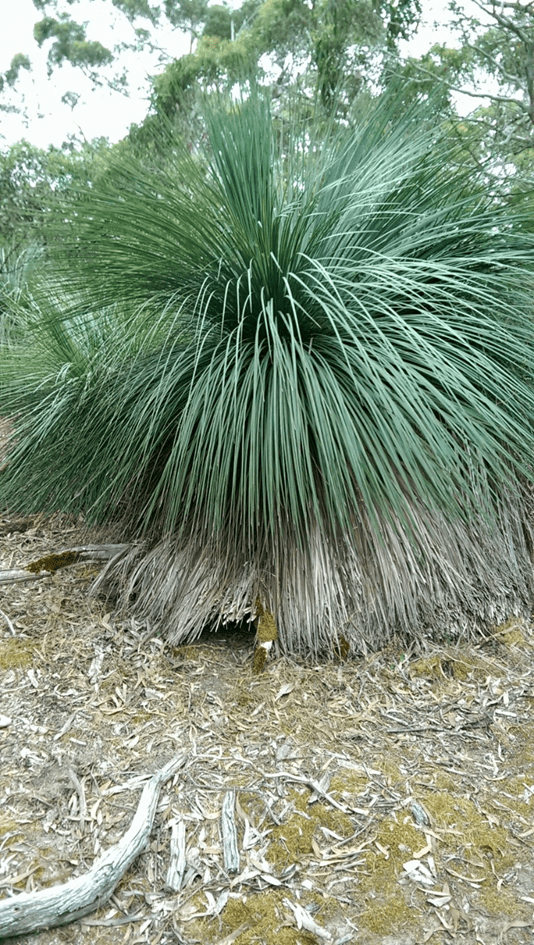
These little huts greatly modify the ecosystems in which X. semiplana is found, providing ‘air-conditioned’ shelters. Temperatures under grass-trees are cooler during the day and warmer at night. On very hot days, temperatures inside the hut of leaves can be 10°C to 20°C cooler than outside. In such condition, the grass tree hut retains higher relative humidity about 10% higher than that of the surroundings. During winter, the grass-tree skirts provide protection from rain and winds. Therefore, grass-trees offer microclimates that are more stable than alternative shelters, and can provide important refuges for wildlife during adverse weather conditions.
Furthermore, the leaves can protect organisms from predators and herbivores, as they can form a dense, spiny cover (Fig. 3). For example, the nationally endangered orchid Caladenia behrii Schltd. is grazed significantly less frequently when it grows in the skirt of X. semiplana than outside, where kangaroos and other species may prevent the orchid from producing reproductive structures. Therefore, grass-trees likely facilitates the persistence of the orchid under heavy grazing pressure. Animals can also hide under grass-tree leaves. Protection from predators and improved microclimates are vital assets for wild animals. The southern bush rats (Rattus fuscipes) indeed select X. semiplana as shelters during foraging, preferring areas with a high density and thick cover of grass-trees.

The grass-tree X. semiplana, therefore, engineers ecosystems to increase habitat quality and breadth for wildlife and flora. It is also a keystone resource, as it offers refuges from predation, herbivory, and extreme weather conditions, as well as important food resources after fire. The species, therefore, has a disproportionally large impact on its environment and facilitates the persistence of biodiversity. The importance of grass trees for native Australian wildlife is probably greater now than ever before, with invasive predators dominating the landscape and extreme heat events becoming more frequent. Given the extraordinary importance of X. semiplana grass-trees in ecosystems, reintroducing the species early during restoration efforts may assist the establishment of healthy ecosystems.
Further Reading:
Kok, X., L. Bruns, G. Guerin, and G. Keppel. early view. Understorey vegetation moderates climate in open forests: The role of the skirt-forming grass tree Xanthorrhoea semiplana F.Muell. Austral Ecology https://doi.org/10.1111/aec.13455.
Petit, S., and D. S. Frazer. 2023. The role of grass-tree Xanthorrhoea semiplana (Asphodelaceae) canopies in temperature regulation and waterproofing for ground-dwelling wildlife. Pacific Conservation Biology 29:445-455. https://doi.org/10.1071/PC23014
Patykowski, J. 2018. Grass trees aren’t a grass (and they’re not a tree). The Conversation (21 September 2018). https://theconversation.com/grass-trees-arent-a-grass-and-theyre-not-trees-100531#:~:text=The%20common%20name%20grass%20tree,the%20bases%20of%20their%20leaves.
 Biodiversity in Oceania