
Refugia constitute the best places to resist the impacts of climate change and to retain biodiversity in rapidly changing landscapes. An international team of leading scientists suggests that management may be required to ensure that refugia retain (or develop) their full potential to protect biodiversity. They propose concrete steps for refugia-focussed management.
Our planet is changing rapidly. Events like the large-scale dieback of trees (Fig. 1), unprecedented heat waves, rapid thawing of glaciers and frozen soil, and more frequent, high-intensity fires, highlight the potential for major changes to biodiversity and ecosystems. The speed and scale of this change is challenging traditional approaches to conservation. For example, traditional protected areas may not shield threatened ecosystems from changes in fire regimes and other environmental conditions.

Alternative management for climate-change adaptation has been proposed and includes approaches to resist, accept, or direct change. The ‘resistance’ of change through conservation and restoration may be the most popular, but needs to occur in areas that are most climatically and ecologically suitable. Climate-change refugia are places that are relatively buffered from climate change and can hence retain biodiversity that the surrounding landscape can no longer support (Fig. 1). They can be considered climatic strongholds with the greatest resistance to environmental change, and hence provide great potential to implement the ‘resist’ approach. However, this approach will be increasingly challenging to implement as climate change intensifies.
Four leading researchers in refugia science, Gunnar Keppel, Diana Stralberg, Toni Lyn Morelli, and Zoltán Bátori, have laid out a framework that facilitates the integration of refugia concepts with conservation and management approaches.
One of the key issues highlighted is the increasing vulnerability of refugia, especially when impacted by other anthropogenic and natural disturbances, and the consequent need to consider management actions. The degree of management needed depends on the capacity of refugia to resist climate change impacts and on how severely they are affected by other disturbances (Fig. 2).
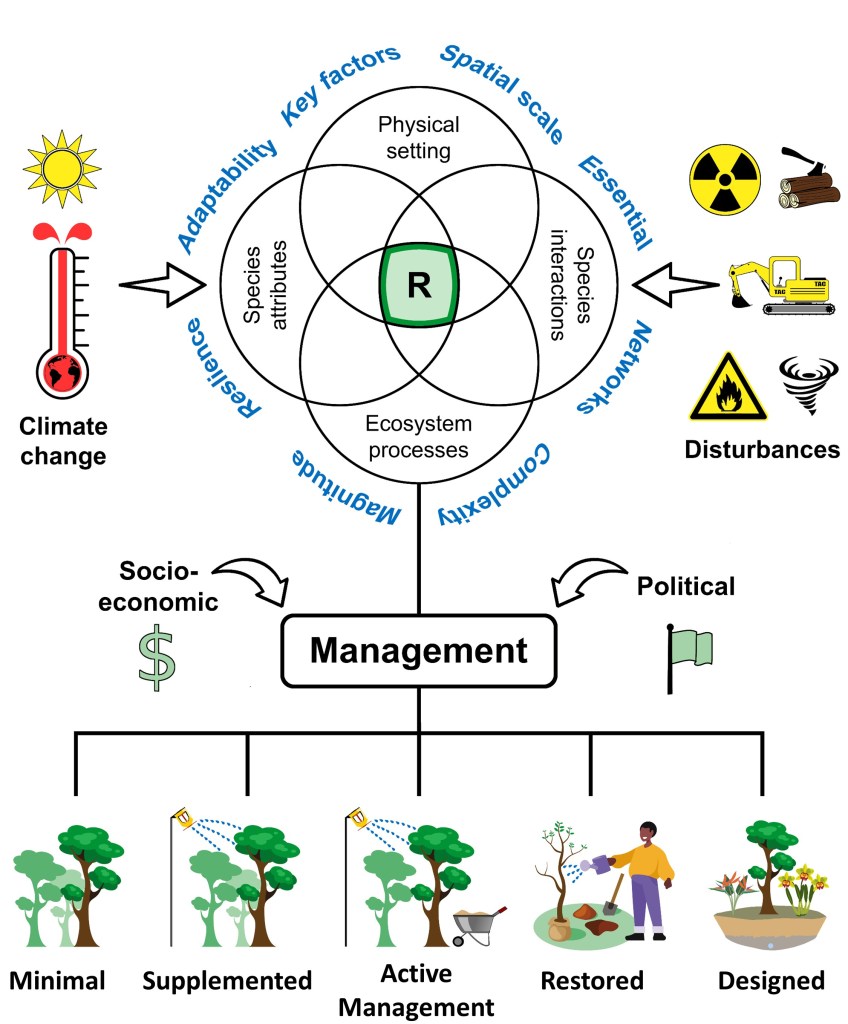
Given that many modern landscapes are highly modified, degraded areas that constitute refugia may require restoration to be able to function as refugia (Fig. 2). If no natural refugia are present in the landscape, refugia can be designed. For example, some topographic depressions that were created as part of mining activities in Hungary now provide refugia for moisture-sensitive species in drying landscapes. Integrating the creation of designed refugia with other activities, such as urban design, would reduce the effort and costs involved.
The authors propose a practical four-step framework to implement the refugia-focussed approach (Fig. 3). Firstly, the ecological communities or taxa for which refugia are to be identified need to be identified. As an example, they refer to a genetically unique population of the red stringybark (Eucalyptus macrorhyncha) that is experiencing high mortality. They suggest that then the thresholds for key factors putting stress on the community or taxon should be identified – for the red stringybark these are likely drought, extreme heat, soil water holding capacity, the intensity of past logging, the contiguous area of healthy woodland remaining, and drift of chemicals used in agriculture (Fig. 3). These thresholds can then be used to identify the locations providing the greatest protection from these stress-inducing factors. Based on the likelihood of thresholds being exceeded within refugia, management actions can then be identified.
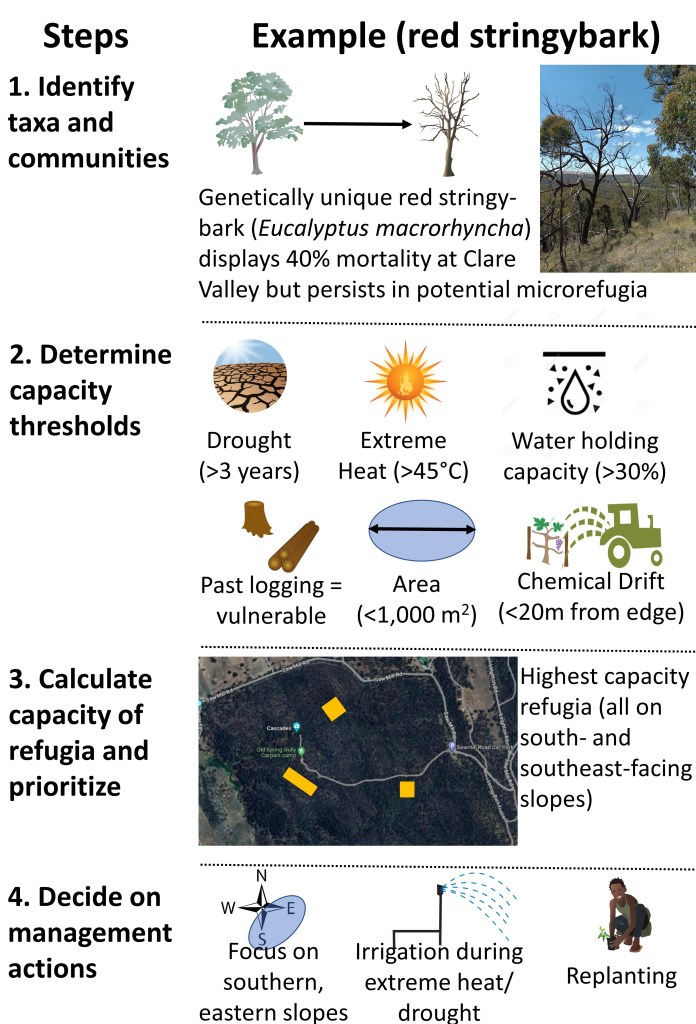
Fig. 3 Applying refugia-focussed management to retain biodiversity in landscapes. The four major steps (left) are supported by an example based on an ongoing project investigating dieback in an isolated population of the red stringybark tree (Eucalyptus macrorhyncha) in the Clare Valley, South Australia. Note that the key factors and thresholds are hypothetical (though plausible). The thresholds are inferred to be three consecutive years below average rainfall for drought, temperatures exceeding 45°C for heat, soil water holding capacity below 30%, the occurrence of past logging, areas <1,000m2 of contiguous healthy woodland, and <20m from the edge to avoid considerable drift of chemicals. Created by GK using images from http://ian.umces.edu/symbols/.
Climate-change refugia therefore provide hope for retaining biodiversity in the landscape and for reducing the number of extinctions under climate change. Given the rapid progression of climate change, it is important that we integrate refugia in conservation planning rapidly and effectively. The article by Gunnar Keppel, Diana Stralberg, Toni Lyn Morelli, and Zoltán Bátori provides a clear roadmap for this integration.
 Biodiversity in Oceania