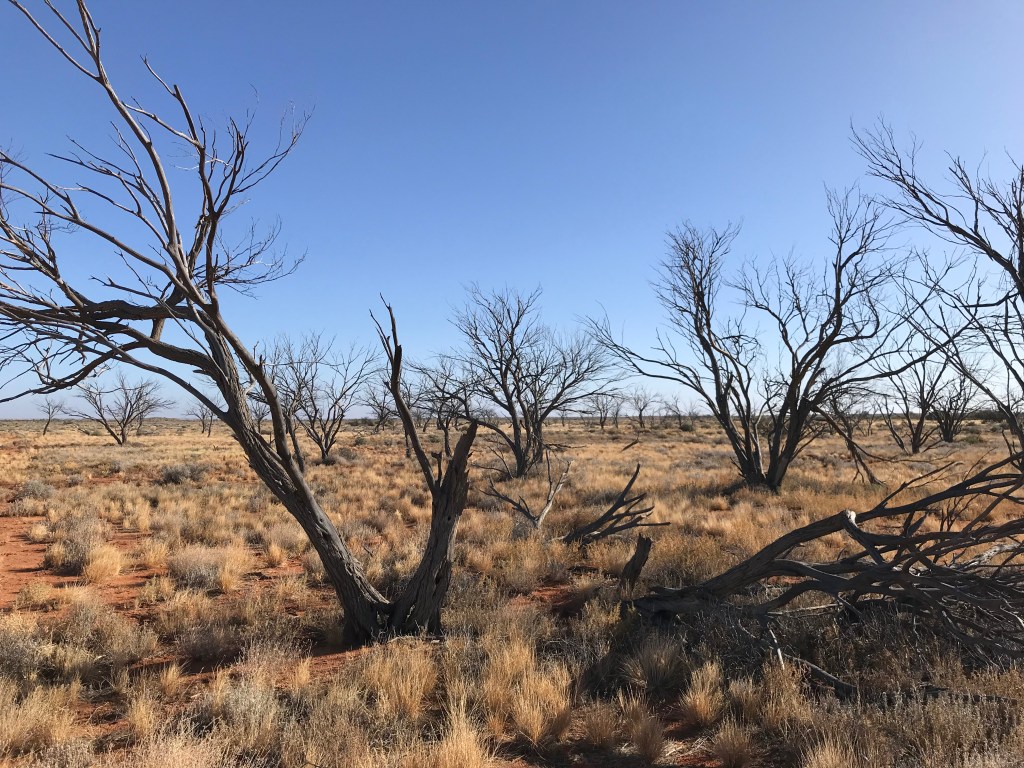
The impacts of climate change are placing increasing stress on organisms. For plants, drought and extreme heat are key stressors that have been intensifying, causing large-scale dieback events in trees (Fig. 1). In Australia, this phenomenon is increasingly being reported and is an emerging concern for the persistence of biodiversity and ecosystems as climate change progresses. This post briefly reviews presentations during a recent symposium that illustrate the nationwide nature of the challenge and highlights ways to become engaged in dieback management.
Understanding and managing dieback due to climate change is increasingly important. This was highlighted during the recent annual conference of the Ecological Society of Australia in Melbourne, which featured a special symposium on dieback titled “Forests against the Machine: facilitating persistence and conservation in dieback-affected native forests and woodlands” (Fig. 2), convened by Chloé Bentze and Gunnar Keppel of the University of South Australia (UniSA). The symposium featured experts from across Australia and was kindly sponsored by the NSW Natural Resources Commission, who have made thre recording of the symposium available here.

Understanding sudden declines observed in forest health requires understanding ‘normal’ background mortality rates, including its patterns and drivers. Ruiling Lu of the Western Sydney University (WSU) showed how a dearth of data is making determining such background rates and identifying any recent changes challenging. This is concerning, given the wide spread of dieback in Australia.
Dieback of native vegetation was reported from four states and territories. Katinka Ruthrof of Department of Biodiversity, Conservation and Attractions in Western Australia highlighted the occurrence of dieback events in many parts of Western Australia, including the iconic jarrah eucalypt forests. Other examples of dieback were presented for stringybark eucalypt forests in South Australia, snow-gum eucalypt forests in the A.C.T., and coastal eucalypt forests in New South Wales. In addition, Aaranya Gayathri Sekaran (WSU) presented on dieback of mulga wattles in the arid zone (Fig 1.). The nationwide nature of this emerging challenge was therefore obvious.
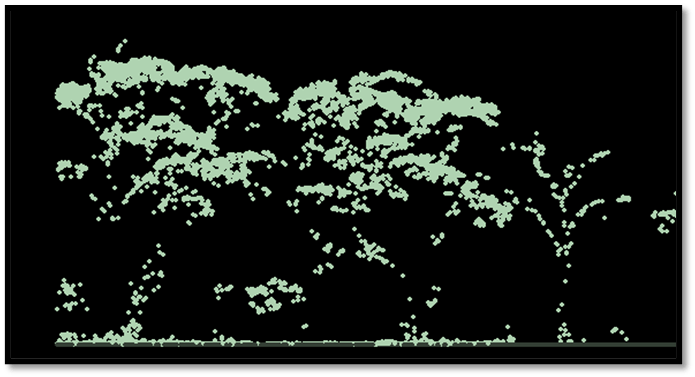
Because of the large spatial scales at which dieback is occurring, remote sensing is increasingly used to study it. Brendan Choat (WSU) used Google Earth imagery to investigate dieback and subsequent recovery in coastal eucalypt forest. Two researchers, Weerach Charerntantanakul (Australian National University, ANU) and Donna Fitzgerald (UniSA), described the novel approaches they are developing to more reliably identify dieback through the integration of various types of imagery and analytical approaches. Donna is integrating multispectral and structural imagery (Fig. 3) to better identify dieback in South Australian stringybarks. Weerach is assessing changes in the canopy condition of subalpine eucalypt woodlands on the Kosciuszko Plateau, producing interactive maps that illustrate recent changes.
There is increasing realization that forest dieback will continue to spread as the impacts of climate change intensify. Several presentations focussed on the broader impacts of dieback and possible management approaches. Chloé Bentze showed that the dieback of stringybark eucalypts (Fig. 4) in the Mount Lofty Ranges is impacting bird species differently, with some woodland specialists declining in abundance in areas with high tree mortality. This implies that the conservation efforts for birds will need to account for future vegetation change caused by climate-induced vegetation dieback.

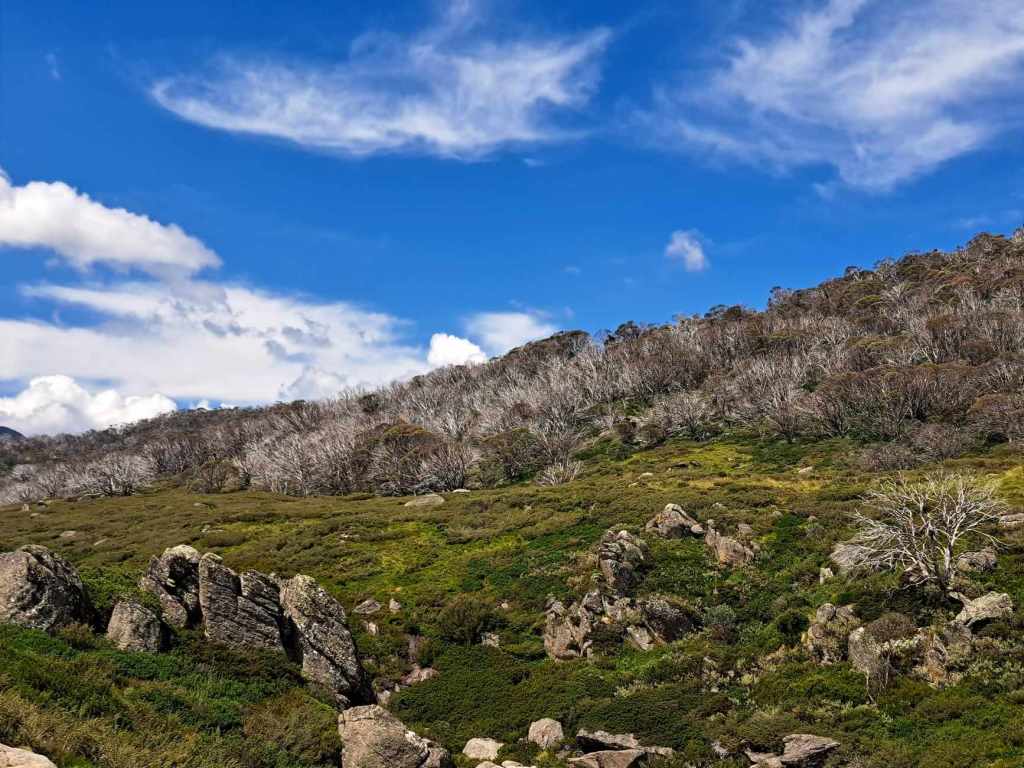
Clearly, managers and stakeholders will need to plan for dieback now to avoid catastrophic declines in biodiversity. Lucy Zarew (ANU) investigated variation in seedling freeze tolerance among snow-gum provenances to gain an understanding of what provenances may be best suited for restoration efforts after large-scale dieback (Fig. 5). Finally, Gunnar Keppel suggested that the resist-accept-direct (RAD) would provide a good basis for managing dieback at the landscape level and that refugia from climate change would provide the best locations to ‘resist’ the impacts of climate change.
Given that the management of dieback requires urgent solutions for environmental managers, landscape planners, and the Australian public, bringing together Australia’s leading researchers in the field of forest dieback was important. It laid the foundation for building a community that can tackle the emerging threat of dieback more effectively. In November this year, Belinda Medlyn (WSU) and Cal Bryant (ANU) are organising a follow-up symposium, titled Beyond the Brink – Navigating vegetation dieback and climate-succession, at the 2025 Conference of the Ecological Society of Australia (ESA2025).
How can you get involved? Is you see dieback, you can report it using the Dead Tree Detective that was established by Belinda Medlyn and her colleagues. Last year, the Dieback and Climate Succession Network (DCSN), organised by Cal Bryant, was established. It is an interdisciplinary, voluntary network of professionals working on research and responses to vegetation dieback and climate-driven vegetation change in Australia. The DCSN aims to foster collaboration and exchange between researchers, land managers, afforestation/ restoration NGOs and state environment departments to promote the uptake, research, and development of effective responses to dieback and climate-driven change in Australian ecosystems. You can sign up to the DCSN here.
 Biodiversity in Oceania