
South Australia is in the midst of a severe drought. Many parts of the state have experienced little to no rain for months, resulting in a water crisis with water tanks and dams running dry. The effects on some of our trees seems to have also been pronounced, with dieback being widely reported (Fig. 1). However, we don’t know how widespread the problem is and are seeking your help to better understand what is happening!
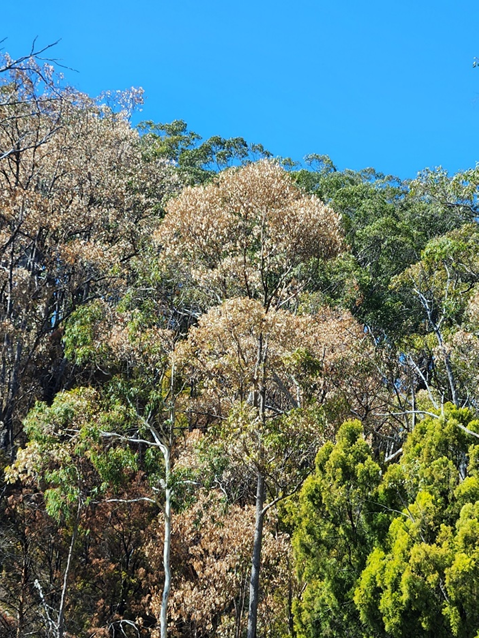
Tree dieback is the decline of crown health in a group of trees, often due to some environmental stress – in this case drought. It often first manifests itself in the browning of leaves (Fig. 1). Ultimately, dieback may result in the premature death of trees (Fig. 2). For example, Chloe Bentze and Donna Fitzgerald, who are researching dieback of stringybark eucalypts in the Mount Lofty Ranges at the University of South Australia, have observed dieback in Black Hill and Belair Conservation Park, and along Greenhill Road and the Southeastern Freeway.

We need to urgently know where dieback is happening and what species are affected to get an idea of the scale of the problem and to be better prepared for future droughts. To make that happen, the stringybark dieback research team at the University of South Australia is teaming up with the Dead Tree Detective team at Western Sydney University, led by Prof. Belinda Medlyn.
You can help by reporting any dieback via the Dead Tree Detective project – available on iNaturalist or Biocollect. Just snap a picture and a GPS location – this will go a long way in understanding the fate of forests in the area. Look for trees with browning leaves (see pictures), a severely degraded canopy (lots of missing foliage), or that are entirely dead (with the bark flaking off in advanced stages). If you can, indicate the species and (very roughly) the number of trees affected
 Biodiversity in Oceania