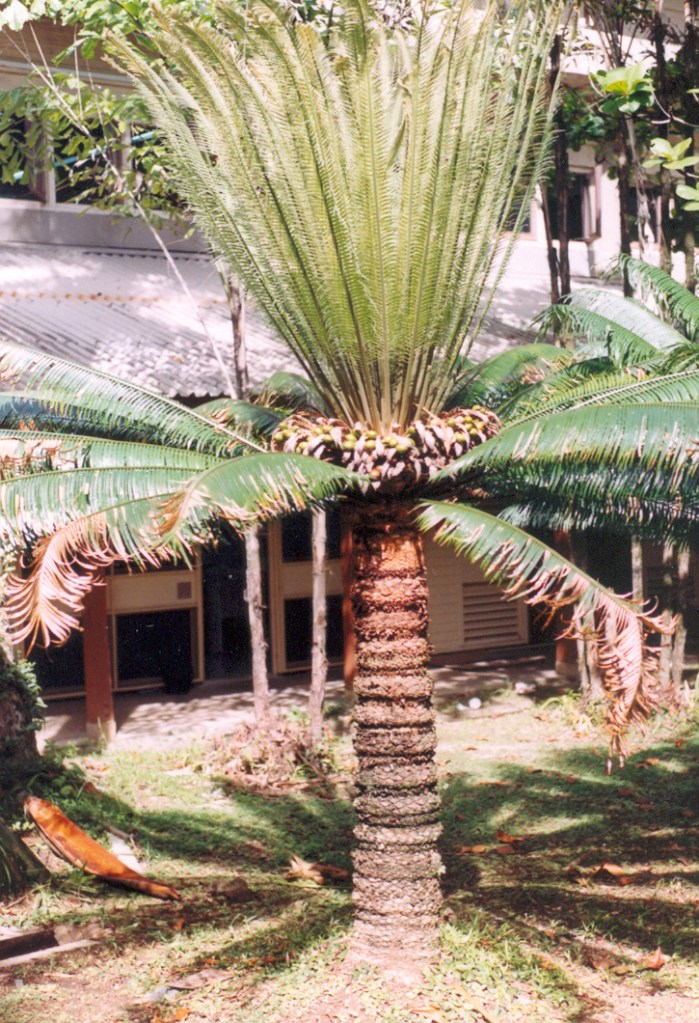
I was recently asked what my favourite plant species is. After some soul searching, I arrived at the the Pacific cycad, Cycas seemannii (Fig. 1), found in Vanuatu, New Caledonia, Fiji, and Tonga. But why, you ask? Cycads are an ancient lineage, believed to have evolved some 300 million years. Their abundance and diversity peaked in the Jurassic and Cretaceous time period – in fact those times are sometimes referred to as ‘The Age of Cycads and Dinosaurs’.
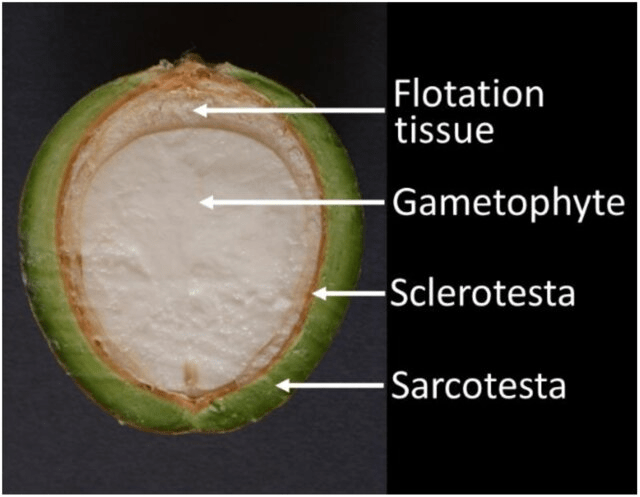
Today, many cycads are considered relicts – restricted to small populations that that are hanging on, often in inhospitable habitats, and have no dispersers for their fruits. But some cycads have bucked that trend. Somewhere, likely in coastal Southeast Asia, the seeds of some cycads evolved a layer in their seeds that gave them buoyancy (Fig. 2) in seawater – only just, seeds tend to sink in brackish water. That open up a new dimension: islands via dispersal across the oceans.
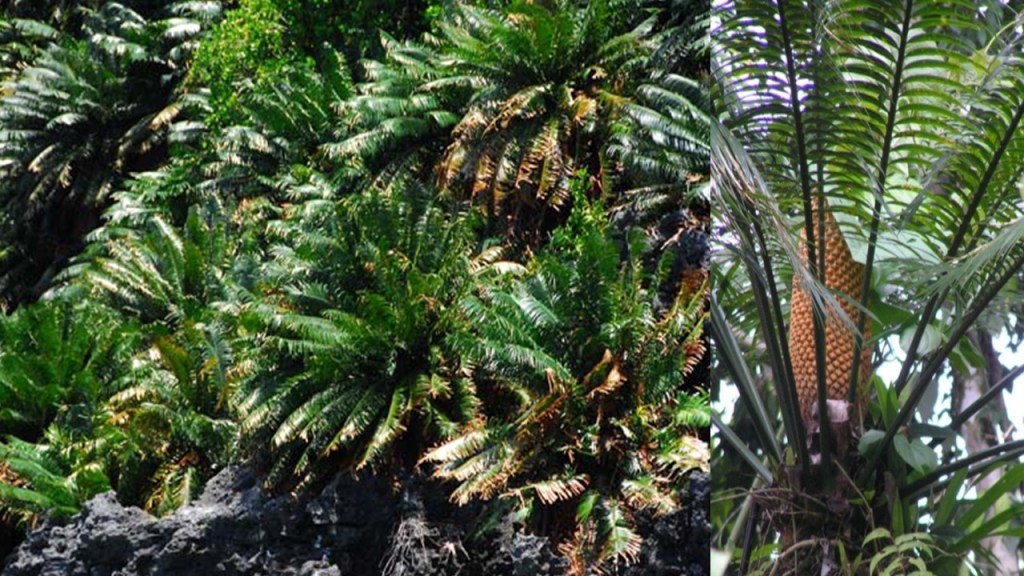
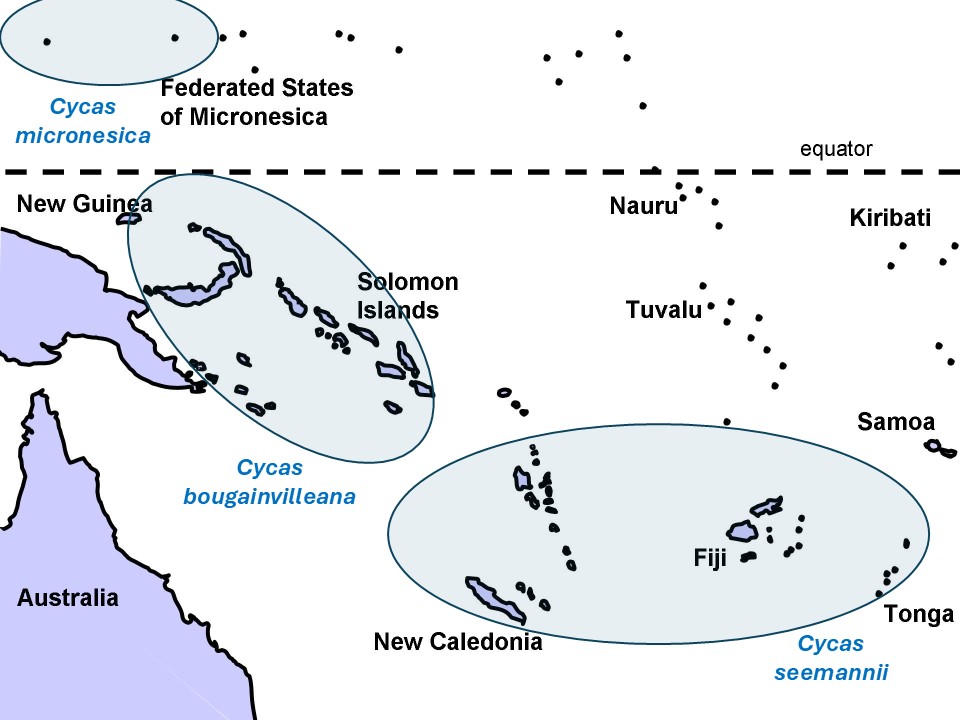
The results were phenomenal, the group of cycads that evolved from these ancestors with buoyant seeds managed to disperse all the way to East Africa and deep into the Pacific. They could hence be considered ‘Supertramps’ – a term coined by Jared Diamond in 1974 for species that can rapidly colonize remote and inhospitable habitats. In the Pacific Ocean, these initial colonistas are now considered to have evolved into three distinct species – one of them being Cycas seemannii (Fig. 3),
Cycads have other adaptations that may assist them with being ‘Supertramps’. Cycas seemannii and other species in the genus Cycas have distinct female cones – they are a loose aggregation of seed-bearing structures, called megasporophylls, that eventually spread outwards like newly produced leaves do (Fig. 4). This allows seeds to fall off once mature and may assist with dispersal. They also have unique roots. In addition to ‘regular’ roots, they also have roots that grow towards the surface and hold photosynthetic symbionts that can fix nitrogen. If you want to find out more about coralloid roots, you can read this recent review. The ability to fix notrogen may allow cycads to establish in places with few accessible nutrients, such as newly formed islands.